
Last reviewed and updated:
Level: Advanced · All guides by level
Most wet runway overruns don’t start with the rain. They start a mile out, with a few knots too much speed and a touchdown too far down the runway. On a wet runway, the braking part of the stop grows roughly with the square of your touchdown speed, so in a simple model 10% too fast means about 20% more braking distance. The tire grip you need to scrub that speed off may be half what it is on a dry day. This guide covers the speeds to fly, how to read braking action reports and runway condition codes (RwyCC), how much margin to add to your landing distance, and the braking technique that keeps you on the pavement. For the tire side of the problem, see The Mechanics of Hydroplaning and the Hydroplaning Speed Calculator.
The short answer: four things keep you on a wet runway
- Fly the correct approach speed. Use the reference speed and any wind or gust additive that your POH, AFM or operator procedures specify, and nothing more. Extra speed “for safety” lengthens the stop.
- Touch down in the touchdown zone. If you are going to land long, go around. A floating touchdown on a wet runway uses up the runway you need for braking.
- Get the weight onto the wheels and brake correctly. Make a firm touchdown, use every deceleration device you have, and brake firmly without locking the wheels.
- Check the landing distance before the approach, with a margin. FAA guidance (AC 91-79B) recommends adding a safety margin of at least 15% to the time-of-arrival landing distance. In moderate or heavy rain, plan for much worse braking than “wet”.
An analogy: braking on a wet motorway
Every driver knows the stopping distance in rain is longer than in the dry. What catches people out is how much longer. Brake from 100 km/h instead of 90 and you need about 23% more distance, because you have 23% more energy to get rid of. Do it on a road where the tires have only half their normal grip, and the distance roughly doubles again. Landing is the same problem, but at 60 to 150 knots, with a runway that ends.
The physics: why speed matters so much
An aircraft’s kinetic energy is ½mV². The brakes have to turn that energy into heat, and the maximum deceleration they can deliver depends on the friction between tire and runway (μ). Ignoring drag, the braking distance is:
d = V² ÷ (2 × μ × g)
Two things follow:
- Speed is squared. 10% extra speed means about 21% more braking distance (1.1² = 1.21).
- Friction is divided. If a wet runway gives half the friction of a dry one, the braking distance doubles.
So the two effects multiply. Too fast and wet is far worse than either one alone.
Limits of this model: the formula describes only the braking segment, with constant friction and no drag. A real landing distance also includes the airborne distance from 50 ft, the touchdown and transition, configuration, spoilers or reverse thrust, and friction that changes along the runway and with water depth. Use it to understand the trend, and use certified performance data for planning.
Worked example: a light single on a wet runway
These figures are illustrative physics only, to show the size of the effects. Use your POH data for real planning.
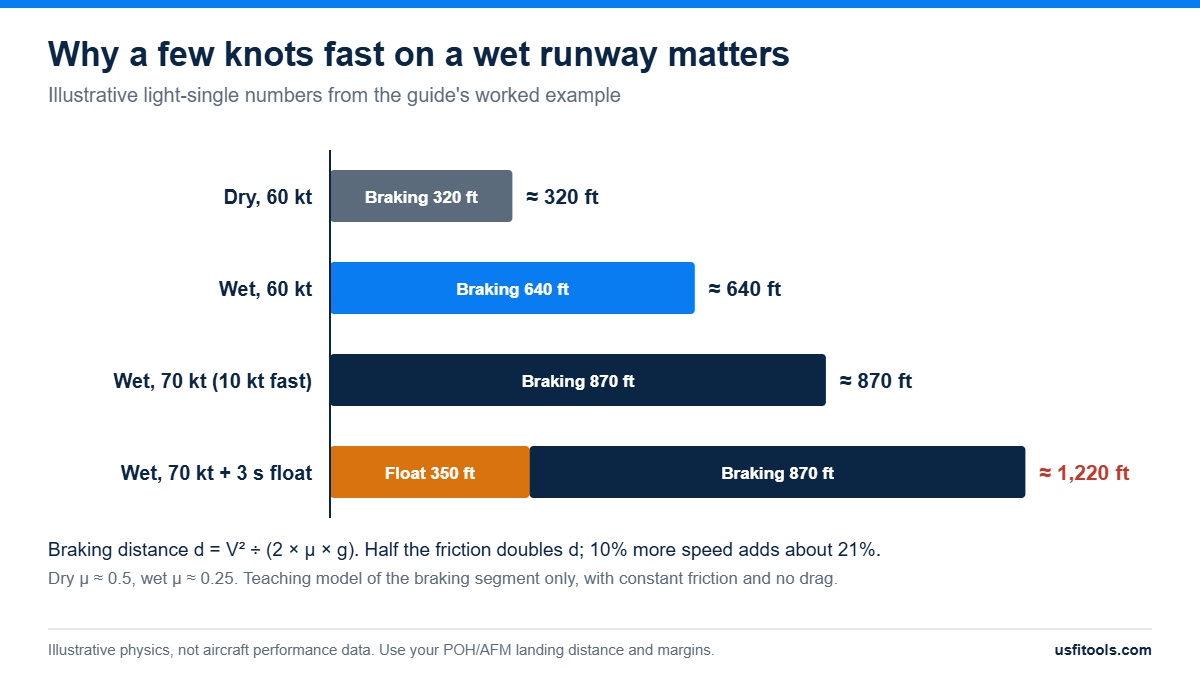
- Touchdown at 60 kt groundspeed (101 ft/s) on a dry runway with good braking (effective μ ≈ 0.5): braking distance ≈ 101² ÷ (2 × 0.5 × 32.2) = about 320 ft.
- Same speed on a wet runway with half the friction (μ ≈ 0.25): about 640 ft.
- On the wet runway, touch down 10 kt fast at 70 kt (118 ft/s): 118² ÷ (2 × 0.25 × 32.2) = about 870 ft.
- Now add a long touchdown. At 70 kt you cover about 118 ft every second. Three seconds of float uses about 350 ft before the wheels even touch.
The total is more than 1,200 ft of ground roll instead of about 320. That is how a runway that looked “plenty long” on a dry day turns into an overrun.
Braking action reports and runway condition codes (RCAM)
Since 2016, US airports have reported runway surface conditions using the FAA’s Runway Condition Assessment Matrix (RCAM), part of the TALPA (Takeoff and Landing Performance Assessment) system. The airport assesses the contaminant on each third of the runway and issues a runway condition code (RwyCC) from 6 (dry) to 0 (nil). Pilots report braking action using matching terms.
| RwyCC | Braking action | Typical runway condition |
|---|---|---|
| 6 | Dry | Dry runway |
| 5 | Good | Wet (damp or 1/8 inch / 3 mm of water or less), frost |
| 4 | Good to Medium | Compacted snow at −15 °C and colder |
| 3 | Medium | “Slippery when wet” runway, and some snow and slush conditions |
| 2 | Medium to Poor | Standing water or slush deeper than 1/8 inch (3 mm) |
| 1 | Poor | Ice |
| 0 | Nil | Wet ice, water on top of compacted snow. A nil runway is closed. |
You will hear the codes as three numbers, one for each third of the runway: “Runway two seven, condition code five, five, three”. That means good braking in the touchdown and middle thirds, and medium in the rollout third. When pilots report medium, poor or nil braking action, the tower adds “Braking action advisories are in effect” to the ATIS.
The trap: “wet” is reported as code 5
A normal wet runway is code 5, “good”. That sounds reassuring, but it assumes a thin film of water. In a May 2026 safety report covering 11 wet runway overruns between 2008 and 2022, the NTSB found that in 10 of them the actual tire friction was well below what the RCAM’s wet-runway value assumes. In most cases the cause was moderate to heavy rain building up water depth. The RCAM jumps straight from code 5 to code 2 at 3 mm of water, but real friction drops steadily as rainfall increases. The NTSB has recommended that the FAA change this (NTSB AIR-26-04). These are recommendations, not rule changes, so check the current RCAM in the AIM.
The practical lesson: if it is raining hard, do not trust “wet, code 5”. FAA guidance (SAFO 19003) says that when moderate or heavier rain is likely on a smooth runway, or heavy rain on a grooved one, you should check that you can stop using a code 2 (medium to poor) landing distance before you start the approach. The same SAFO notes that a runway going from wet to contaminated can need 30–40% more stopping distance.
How much margin to add to the landing distance
- Time-of-arrival check (before each landing): FAA Advisory Circular 91-79B recommends a landing distance assessment before landing when conditions differ from the preflight plan, with a safety margin of at least 15% added to the operational landing distance.
- Predeparture (dispatch) runway rules for large turbine airplanes: these work on runway length, not on the raw flight-manual distance. Under 14 CFR 121.195(b) and 135.385(b), the airplane must be able to make a full stop within 60% of the effective runway length at the destination. For a turbojet, if the runway may be wet or slippery on arrival, paragraph (d) of each rule requires the effective runway length to be at least 115% of that paragraph (b) requirement, unless a shorter distance has been approved from actual wet-runway landing techniques. Section 135.385 covers large transport category turbine airplanes and has its own exceptions, including an 80% option for eligible on-demand operators with an approved destination airport analysis. Fractional ownership operations under 14 CFR 91.1037 have their own rule. Check the exact rule for your aircraft and type of operation.
- Synthetic example (illustrative numbers, not real aircraft data): a certified dry landing distance of 3,000 ft gives a dry predeparture requirement of 3,000 ÷ 0.60 = 5,000 ft of effective runway. If wet or slippery conditions are possible, the requirement becomes 5,000 × 1.15 = 5,750 ft. Multiplying the 3,000 ft figure by 1.15 (3,450 ft) would understate it by 2,300 ft. This dispatch check is separate from the time-of-arrival assessment above.
- Light aircraft: most POH charts are for a dry, paved, level runway with a specific technique. Apply the POH corrections for wind and slope, then add a generous margin for wet grass or pavement. The FAA’s 15% is a minimum, not a target, and the FAA itself says it may not be enough in heavy rain.
Speed control on the approach
- Fly a stabilized approach. On speed, on path and configured by your stabilization height. If you are not, go around.
- Use only the additive your procedures specify. Many light-aircraft POHs and instructors use half the gust factor, but follow your own aircraft and operator procedures. Adding extra speed “for the wife and kids” on a wet day is a common way to land 10 to 15 kt fast.
- Watch your groundspeed. A tailwind adds directly to touchdown groundspeed, and stopping distance grows with the square of it. Many operators limit tailwind landings to 10 kt or less, and on a wet runway the safest tailwind is none. Choose the into-wind runway even if it means a longer taxi.
- Do not float. Cross the threshold at the right height and speed, and put the aircraft down in the touchdown zone. On a wet runway, many instructors teach a firm touchdown to break through the water film and spin the wheels up.
- Set a go-around trigger. Brief it before the approach: “If I’m not on the ground by the second taxiway, I go around.”
Braking technique on a wet runway
These are general principles for understanding. The correct technique for your aircraft, including flap handling, spoilers, reverse or beta and braking with or without anti-skid, is the one in your POH, AFM or operator procedures.
- Lower the nose wheel promptly (nosewheel aircraft) for directional control, then use aerodynamic and mechanical deceleration together.
- Get the weight onto the main wheels. Spoilers or lift dumpers, if fitted, do this. In many light aircraft, retracting the flaps after touchdown does the same, but follow your POH, and confirm you are moving the flap lever, not the gear lever.
- Use reverse thrust or beta early if available, when it is most effective at high speed.
- Brake firmly and smoothly, without locking the wheels. With anti-skid, apply steady firm pressure and let the system work. Without it, brake progressively. If you feel a wheel lock or skid, release the pressure and reapply. A locked wheel on a wet runway is how reverted rubber hydroplaning starts.
- Keep straight. Steering and braking compete for the same limited grip. In a crosswind, keep aileron into wind and avoid harsh braking on one side.
- Report the braking action to ATC after landing (“braking action medium, Cessna 172”). It is the most useful information the next pilot can get.
When to hold, divert or go somewhere else
- Heavy rain falling on the runway now, especially if it is not grooved.
- Braking action reported as poor, or condition codes of 2 or lower.
- A tailwind on the only available runway.
- The landing distance with your margin is longer than the runway available.
- Your approach is not stable, or you are carrying extra speed you cannot lose.
Holding for 15 minutes while a heavy shower passes costs fuel and time. An overrun costs much more. Build this into your PAVE risk assessment and your aviation weather briefing checklist before you depart.
Pre-approach briefing checklist for a wet runway
- Latest METAR, ATIS and any runway condition codes or braking action reports
- Rain intensity: light, moderate or heavy (+RA)? Is the runway grooved?
- Wind and the runway that gives a headwind
- Landing distance from the POH or AFM, with the wet or contaminated correction and at least a 15% margin
- Target speed, touchdown point and go-around point
- Deceleration plan: flaps or spoilers, reverse, braking technique
- Your hydroplaning speed compared with your touchdown groundspeed
Frequently asked questions
What does “braking action medium” mean?
Braking deceleration is noticeably reduced for the braking effort applied, or directional control is noticeably reduced. It corresponds to runway condition code 3.
When does a wet runway become contaminated?
When more than 25% of the runway surface is covered by more than 1/8 inch (3 mm) of water, slush or similar contaminant. The condition code then drops to 2 (medium to poor) or lower.
How much longer is the landing distance on a wet runway?
It depends on the aircraft, the runway surface and the water depth. For large turbojets under Parts 121 and 135, the wet-runway dispatch rule requires 15% more runway than the dry dispatch requirement, which itself only allows the airplane to use 60% of the runway. FAA guidance says contaminated conditions in heavy rain can need 30–40% more stopping distance than wet, so treat 15% as the floor.
What speed should I land at on a wet runway?
The normal reference speed from your POH or AFM, plus only the wind or gust additive it specifies (half the gust factor is common in light aircraft). Landing faster “for safety” makes the landing roll much longer, because stopping distance grows with the square of speed.
Sources (checked 10 November 2026): FAA Advisory Circular 91-79B, Aircraft Landing Performance and Runway Excursion Mitigation (2023); FAA SAFO 16009, Runway Assessment and Condition Reporting (TALPA), and SAFO 19003, Turbojet Braking Performance on Wet Runways (2019), both in the FAA SAFO library; NTSB AIR-26-04, Accounting for the Progressive Decrease in Runway Friction Associated with Increasing Rainfall Intensity (May 2026); Aeronautical Information Manual, Chapter 4 (braking action reports and advisories); 14 CFR 121.195 and 14 CFR 135.385; FAA Airplane Flying Handbook (FAA-H-8083-3C), Chapter 9.
Related: Hydroplaning Speed Calculator · Hydroplaning Explained · Crosswind & Headwind Calculator · METAR & TAF Weather · Aviation Photo Quiz