
Last reviewed and updated:
Level: Intermediate · All guides by level
A visual descent point (VDP) is the point on a non-precision approach where you can leave the MDA and start a normal descent to the runway, if you have the required visual references. On a 3° path you lose about 318 ft per nautical mile, so the VDP is roughly height above touchdown ÷ 300 NM from the threshold. A 700 ft HAT puts it about 2.3 NM out. This guide explains why VDPs exist, how to calculate one when it is not published, and how to use it without breaking the rules. Work through your own numbers with the VDP Calculator.
An analogy: the motorway exit
Think of an exit ramp. Take it too early and you end up on the verge. Take it too late and you brake hard and swerve. There is one sensible point to turn off. A non-precision approach is the same: you fly level at the MDA, and somewhere along that level segment is the point where a normal, stable descent to the touchdown zone begins. That point is the VDP.
Why VDPs exist: “dive and drive”
Older non-precision approaches were often flown as “dive and drive”: descend quickly to the MDA, then fly level until the runway appears. The problem comes after that. If you see the runway late, close to the threshold, the only way to land is a steep, fast descent, which is a classic setting for unstable approaches and runway overruns. If you leave the MDA too early, you are below a normal glide path in the area where obstacles are closest to the approach path.
The VDP solves both. It tells you the earliest point where a normal descent makes sense, and it gives you a mental cue: if you reach the VDP and still do not have the runway, the chances of a safe, normal landing are falling fast.
How a VDP appears on the chart
On FAA charts, a published VDP is shown in the profile view as a bold V at the point along the MDA segment, usually with a DME or along-track distance. Some VDPs are published for one set of minimums only, and some approaches have no VDP at all. The procedure designer may leave it out when obstacles penetrate the visual descent surface. When there is no VDP, many pilots work out their own as a planning aid, but the absence of a published one is itself useful information.
The math
A 3° descent path drops tan(3°) × 6,076 ft = 318 ft per nautical mile. So:
- HAT = MDA − touchdown zone elevation (TDZE)
- VDP distance from threshold = HAT ÷ 318 (or HAT ÷ 300 as a quick rule)
- Timing method, when the missed approach point is the threshold: start down about HAT ÷ 10 seconds before the MAP. This rule is most accurate at about 110–120 kt groundspeed.
- Descent rate from the VDP ≈ groundspeed × 5.3 ft/min for a 3° path.
If the approach shows a different vertical descent angle (VDA), use that angle instead of 3°. The height lost per NM is tan(angle) × 6,076.
Worked example
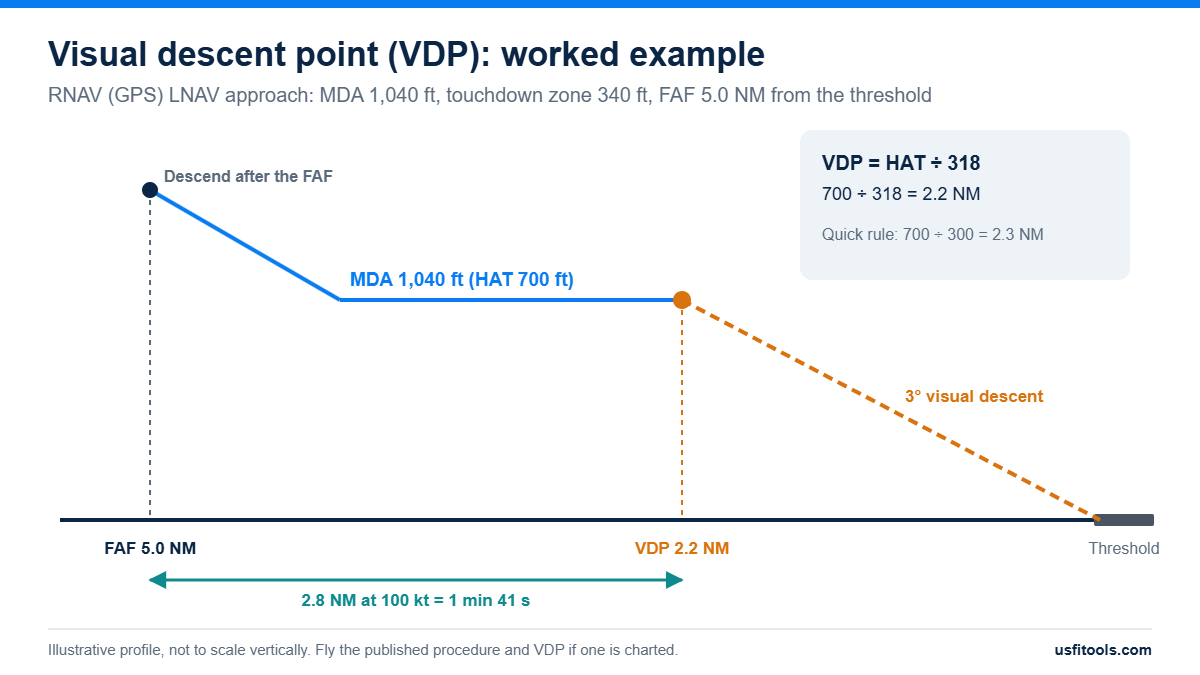
An RNAV (GPS) approach with LNAV minimums has an MDA of 1,040 ft. Touchdown zone elevation is 340 ft. The FAF is 5.0 NM from the threshold, which is also the MAP. You fly final at 100 kt groundspeed.
- HAT = 1,040 − 340 = 700 ft
- VDP = 700 ÷ 318 = 2.2 NM from the threshold (quick rule: 700 ÷ 300 = 2.3 NM)
- Distance FAF → VDP = 5.0 − 2.2 = 2.8 NM. At 100 kt: 2.8 ÷ 100 × 60 = 1 min 41 s after the FAF
- Time from VDP to the threshold at 100 kt = 2.2 ÷ 100 × 3,600 = 79 seconds (HAT ÷ 10 gives 70 s, a little early at this slow speed)
- Descent rate from VDP = 100 × 5.3 ≈ 530 ft/min
In the cockpit, you would brief: “Level at 1,040, VDP at 2.2 miles, about 1 min 40 after the FAF, then about 500 down if I have the runway.”
The rules that still apply
A VDP never replaces the regulation. Under 14 CFR 91.175(c), you may only descend below the MDA when the aircraft is continuously in a position to descend to a landing on the intended runway at a normal rate using normal maneuvers, the flight visibility is at least what the approach requires, and at least one of the listed visual references for the runway is distinctly visible and identifiable. Reaching the VDP gives you no new permission. It only tells you that a normal descent would start here if those conditions are met.
The VDP is also not the missed approach point. If you reach the VDP without the visual references, you can continue level at the MDA to the MAP, and you might still see the runway in time. But the descent from a later point will be steeper than normal, so many operators and instructors teach that if you are not visual at the VDP, you should expect to go around.
Practical limitations
- A self-calculated VDP does not guarantee obstacle clearance below the MDA. Only the visual segment and your visual references protect you there.
- Check what the published distance is measured to. A DME reading may be measured to a VOR or to a navaid that is not at the threshold.
- Use the actual groundspeed on final. Planned TAS can be off by 20 kt or more in a strong wind, which moves the timing.
- Cross-check the descent with a VASI or PAPI if the runway has one.
- Where an approach offers LNAV/VNAV or LPV minimums and your equipment supports them, the vertical guidance gives you a stabilised path and the VDP question largely goes away.
Frequently asked questions
Can I descend below MDA at the VDP without seeing the runway?
No. Descending below MDA always requires the 91.175(c) conditions: being in a position for a normal descent, the required flight visibility, and the required visual references.
Is the VDP the same as the missed approach point?
No. The VDP is where a normal descent should start. The MAP is where you must go around if you do not have the required visual references. On most approaches the VDP comes before the MAP.
Why does my GPS show a VDA but no VDP?
The vertical descent angle shows the published descent path from the FAF and is advisory only on LNAV approaches. A VDP is a separate fix and may be left off the chart, for example because of obstacles in the visual segment.
Sources: FAA Aeronautical Information Manual, Chapter 5, Section 4 (instrument approach procedures and charts); FAA Instrument Procedures Handbook (FAA-H-8083-16B); FAA Instrument Flying Handbook (FAA-H-8083-15B); 14 CFR 91.175.
Related tools: VDP Calculator · Descent Rate & Top of Descent Calculator · IFR Alternate Requirements: the 1-2-3 Rule