
Last reviewed and updated:
Level: Student pilots · All guides by level
Eights-on-pylons is the commercial maneuver where you fly a figure eight around two points on the ground while keeping your wingtip reference line “stuck” on each pylon. The trick is the pivotal altitude: groundspeed in knots squared ÷ 11.3 gives the height in feet above the ground where the pylon appears to pivot. At 100 kt that is about 885 ft AGL. This guide explains why the number works, why it changes around the eight, and how to fly it. Work out your own numbers with the Pivotal Altitude Calculator.
An analogy: the camera on a turntable
Imagine a camera on a long arm, circling a statue. If the arm is the right length for the camera’s speed, the statue stays centred in the frame. Speed up without changing the arm and the statue drifts back in the frame. Slow down and it drifts forward. In eights-on-pylons, the airplane is the camera, your wingtip is the frame line, and the “arm length” is set by your height. At pivotal altitude the pylon stays on the wingtip. When groundspeed changes, the right height changes with it.
Where the formula comes from
Look along the wingtip at the pylon. For the pylon to stay fixed on that line, the line of sight must rotate at exactly the same rate as the airplane turns over the ground. Working through the geometry of a coordinated turn gives a neat result: the required height depends only on groundspeed.
h = V² ÷ g, where V is groundspeed in feet per second and g is 32.174 ft/s².
Converting units gives the familiar rules:
- Knots: 1 kt = 1.688 ft/s, so h = GS² × 1.688² ÷ 32.174 = GS² ÷ 11.3
- Miles per hour: 1 mph = 1.467 ft/s, so h = GS² ÷ 15
Two things are missing from the formula: bank angle and aircraft type. A faster airplane needs more height only because it has more groundspeed. The bank angle is not something you choose. It is whatever it takes to keep the reference line on the pylon at pivotal altitude, so it changes around the eight.
Why the altitude changes around the eight
Because height depends on the square of groundspeed, even a light wind makes a noticeable difference.
- Downwind, groundspeed is highest, so pivotal altitude is highest.
- Upwind, groundspeed is lowest, so pivotal altitude is lowest.
- Between the two, the altitude flows smoothly up and down. You climb as you turn downwind and descend as you turn into wind.
That is why eights-on-pylons is not flown at a constant altitude. On a calm day it nearly is. On a windy day the altitude band can be 300–400 ft.
Worked example
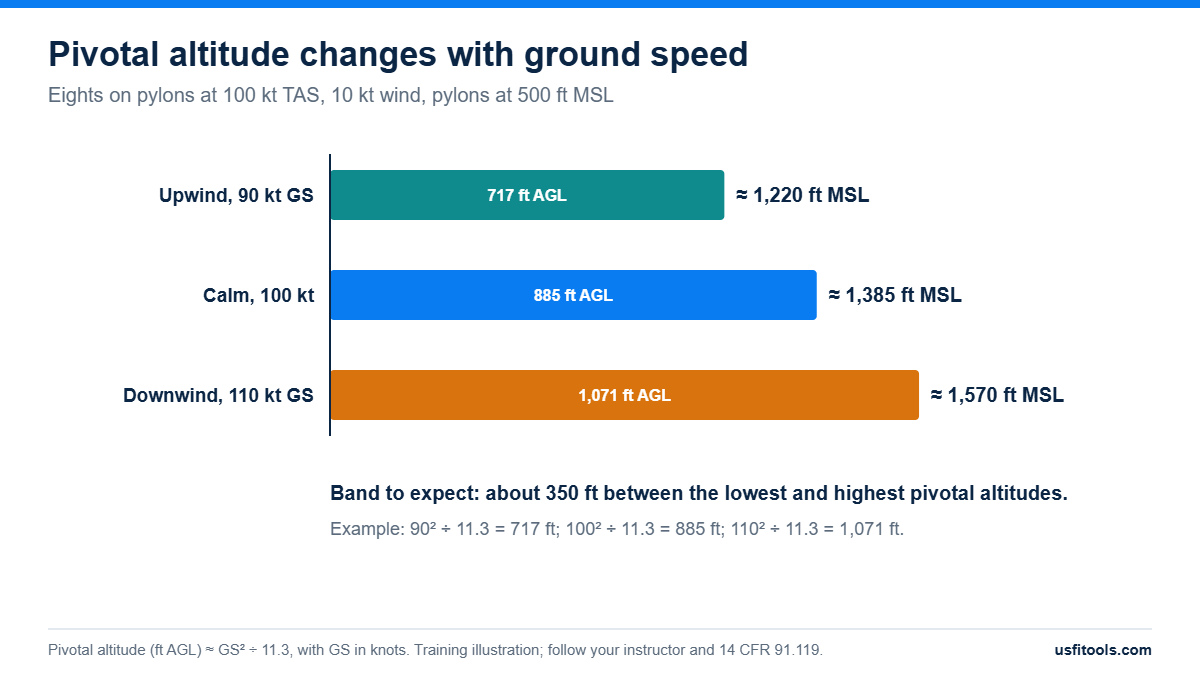
You will fly the maneuver at 100 kt true airspeed. Wind is 10 kt and the pylons are on ground at 500 ft MSL.
- Calm-wind pivotal altitude: 100² ÷ 11.3 = 885 ft AGL → 1,385 ft MSL. Use this as your entry altitude.
- Upwind (90 kt GS): 90² ÷ 11.3 = 717 ft AGL → about 1,220 ft MSL.
- Downwind (110 kt GS): 110² ÷ 11.3 = 1,071 ft AGL → about 1,570 ft MSL.
- Band to expect: about 350 ft between the lowest and highest points.
Write the three altitudes on your kneeboard before the flight. In the air, you will not fly to these numbers exactly. You will fly to the pylon, and the numbers tell you roughly where you should be.
How to fly it
- Pick the pylons. Choose two easily seen points, such as isolated trees or road intersections, on a line roughly perpendicular to the wind, far enough apart for 3–5 seconds of straight and level flight between turns. Make sure the area allows a safe forced landing and that pivotal altitude keeps you legally clear of people and structures.
- Enter downwind, on a 45° angle between the pylons, at the calm-wind pivotal altitude or slightly above it.
- Turn toward the first pylon as it comes abeam, so the reference line falls on it.
- Correct with altitude, not rudder. If the pylon moves ahead of the reference line, you are above pivotal altitude: descend slightly. If it falls behind, you are below: climb slightly. Using rudder to swing the wingtip back is the classic mistake, and the examiner will see it as a skid or slip.
- Roll out and cross between the pylons, then turn the opposite way around the second pylon.
What the examiner is looking for
The FAA Commercial Pilot Airman Certification Standards task for eights-on-pylons asks you to work out the approximate pivotal altitude, choose suitable pylons, keep the reference line on each pylon with only small “pivoting” movements, use proper coordination, and divide your attention between the airplane, the pylons and outside traffic. You are also expected to keep the airspeed within the stated tolerances. Check the current ACS for the exact tolerances, because they are updated from time to time.
Safety limitations
- Pivotal altitude for a slower trainer can be under 600 ft AGL. Check 14 CFR 91.119 minimum safe altitudes, your school’s procedures and the terrain. If the numbers put you too low, choose a different area or speed.
- Low-altitude maneuvering leaves little time to deal with an engine failure. Always know where you would land.
- Your eyes are mostly outside on the pylon. Keep scanning for traffic and watch for high-wing blind spots in the turn.
- Do not chase the pylon with steep bank or uncoordinated control inputs. If it gets away from you, roll out, reposition and enter again.
Frequently asked questions
Should I use true airspeed or groundspeed?
Groundspeed. TAS is useful for planning the calm-wind value. The wind then changes groundspeed around the eight, which is what moves pivotal altitude.
Is pivotal altitude above ground or above sea level?
The formula gives height above the ground (AGL). Add the pylon elevation to get the altitude to fly on your altimeter.
Does bank angle affect pivotal altitude?
No. The bank angle varies around the eight as a result of holding the reference line, but it does not appear in the formula.
Sources: FAA Airplane Flying Handbook (FAA-H-8083-3C), Chapter 7 (Ground Reference Maneuvers); FAA Commercial Pilot – Airplane Airman Certification Standards (FAA-S-ACS-7B); 14 CFR 91.119 (minimum safe altitudes).
Related tools: Pivotal Altitude Calculator · Turn Rate & Radius Calculator · Standard Rate Turn Explained