
Last reviewed and updated:
Level: Intermediate · All guides by level
A rolling tire starts to hydroplane at about 9 × √(tire pressure) knots, and a tire that is not yet spinning at touchdown starts at about 7.7 × √(tire pressure). For a light aircraft with 30 psi tires, that is around 49 kt on takeoff and only 42 kt at touchdown, below many normal landing speeds. This guide explains why, what tire pressure and the runway surface each do, and what you can actually control. Check your own numbers with the Hydroplaning Speed Calculator.
An analogy: the water skier
A water skier sinks when the boat is slow and rises onto the surface once the boat is fast enough. The ski pushes water down and forward, and at speed that water cannot get out of the way quickly enough, so it pushes back up. An aircraft tire on a flooded runway is in the same position. Below a certain speed the tread squeezes the water out of the footprint. Above it, a wedge of water builds under the front of the tire and lifts it off the pavement. With rubber riding on water, you have almost no braking and almost no steering.
The three types of hydroplaning
1. Dynamic hydroplaning
Dynamic hydroplaning needs standing water deeper than the tire tread can channel away, commonly taken as about 0.1 inch (2.5–3 mm) or more. Speed builds water pressure under the tire. When that pressure balances the load on the tire, the tire lifts off completely. This is the only type with a well-tested formula.
2. Viscous hydroplaning
Viscous hydroplaning needs only a thin film of water, but on a very smooth surface. The classic place is the touchdown zone of a busy runway, where years of tire rubber have filled the texture of the pavement. The water acts like a lubricant on that smooth rubber. It can happen at speeds well below dynamic hydroplaning, and no simple formula predicts it.
3. Reverted rubber hydroplaning
Reverted rubber hydroplaning starts with a locked wheel. As the tire skids, friction heat turns the water in the footprint to steam, and the rubber softens and “reverts” to an uncured state. The tire then rides on a steam cushion with a patch of melted rubber, often leaving a white, steam-cleaned streak on the runway. It can happen at any speed during a long locked-wheel skid. The cure is not to lock the wheels in the first place.
The physics behind 9√P and 7.7√P
NASA Langley research on aircraft tires, led by Walter B. Horne, found that the speed at which a tire fully hydroplanes on a flooded surface depends mainly on tire inflation pressure. The reasoning is straightforward. The pressure in the tire footprint is roughly equal to the inflation pressure. The water under it creates a dynamic pressure that grows with the square of speed, about ½ρV². Hydroplaning begins when the water pressure matches the footprint pressure. Solve that for V and speed grows with the square root of tire pressure.
Fitting real test data gave two practical relationships, in knots, with P in psi:
- Spin-down, tire already rolling (takeoff, or after the wheels have spun up): Vp ≈ 9√P
- Spin-up, tire not yet rotating (the moment of touchdown): Vp ≈ 7.7√P
The touchdown value is lower because a stationary tire cannot push water out of its own path as it arrives. The water builds up under it more easily, and once that happens the tire may never spin up at all.
Tire pressure versus runway surface
The two factors pull in different directions.
- Tire pressure sets the speed for dynamic hydroplaning. Higher pressure means a smaller, firmer footprint that pushes water away better. That is why airliners with 200 psi tires have hydroplaning speeds above 110 kt, while a light single with 30 psi tires can hydroplane in the low 40s. Under-inflated tires lower the speed further.
- Water depth decides whether dynamic hydroplaning can happen at all. If the water is shallower than the tread can drain, the formula does not apply, but friction is still reduced.
- Surface texture controls viscous hydroplaning. Grooved runways and porous friction courses give water somewhere to go. A smooth surface coated with rubber can be slippery at low speed with only a damp film.
- Tread depth matters too. A worn tire has less channel volume to carry water out, which lowers the effective hydroplaning speed.
Worked example
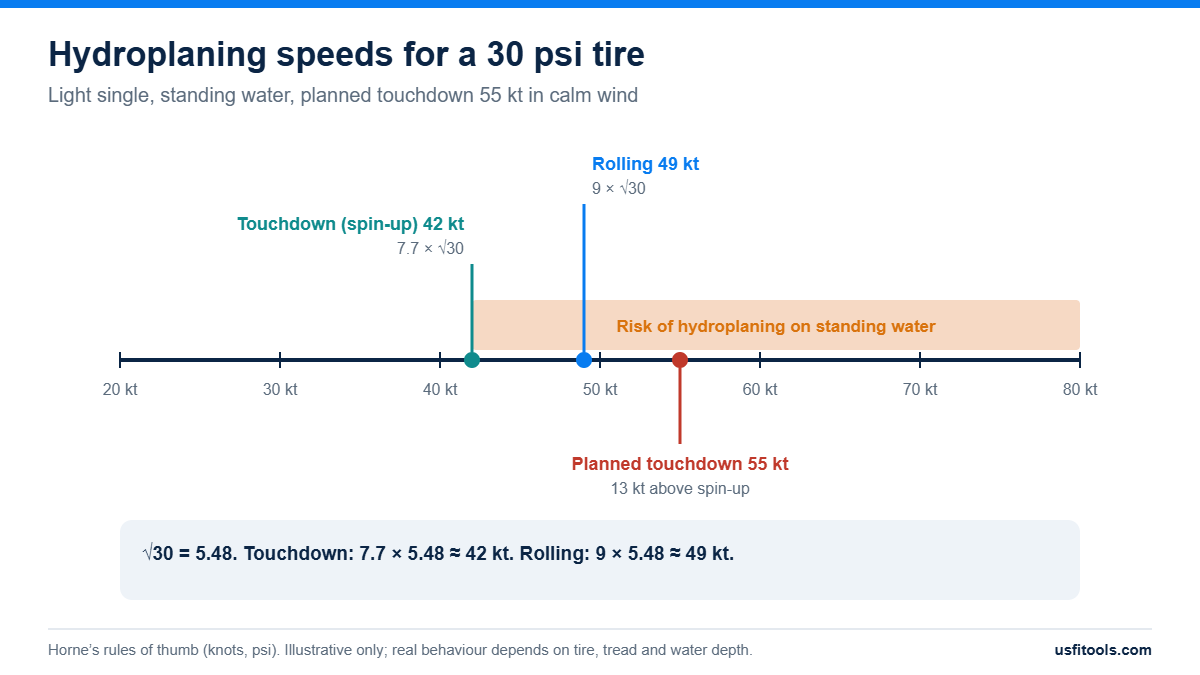
A pilot flies a light single with main tires inflated to 30 psi. Heavy rain has left standing water on the runway. The planned touchdown speed is 55 kt with calm wind.
- √30 = 5.48
- Touchdown hydroplaning speed: 7.7 × 5.48 = 42 kt
- Rolling hydroplaning speed: 9 × 5.48 = 49 kt
- The aircraft touches down at 55 kt, 13 kt above the spin-up value. The wheels may not spin up until the aircraft slows to about 42 kt. Until then the pilot has little braking and steering, so the aircraft rolls on water for several hundred feet.
- If the same tires were 5 psi low (25 psi), the touchdown value drops to 7.7 × 5 = 38.5 kt, extending that uncontrolled slide.
Now compare an airliner with 200 psi main tires: 7.7 × 14.1 = 109 kt at touchdown. With a typical touchdown speed of 130–140 kt it is also above the threshold. Hydroplaning is not just a light-aircraft problem.
Practical safety limitations
- Do not land fast. Every knot over the target speed is a knot of hydroplaning margin lost and extra distance on a low-friction surface.
- Land firmly. A positive touchdown helps break through the water film and spin the wheels up.
- Use aerodynamic drag first. Hold the nose up (where the type allows), and use flaps, spoilers or reverse thrust as available while the wheels are spinning up.
- Brake gently and never lock the wheels. Moderate braking once the wheels are turning. Anti-skid systems do this for you on many aircraft; in a light aircraft you must do it by feel.
- Treat crosswinds with extra respect. A hydroplaning tire cannot resist weathervaning, so the aircraft drifts and turns into wind.
- Use the right performance data. Wet and contaminated runway figures in the flight manual, and runway condition reports, matter more than any rule of thumb. Add a generous margin when they are not available.
- Check tire pressure before flight. It is the one hydroplaning input you control on the ground.
Frequently asked questions
Can you hydroplane on takeoff?
Yes. On a flooded runway, a rolling tire can hydroplane above about 9√P, and you lose steering during the takeoff roll. In a rejected takeoff at that speed, braking will also be poor.
Does a heavier aircraft hydroplane at a higher speed?
Not directly. The formula uses tire pressure, and tire pressure is chosen to suit the aircraft’s weight. Weight affects the result through the pressure the manufacturer specifies.
Is aquaplaning the same as hydroplaning?
Yes. “Aquaplaning” is more common in British and ICAO usage, and “hydroplaning” in FAA material.
Sources: NASA Langley Research Center: Horne and Dreher, Phenomena of Pneumatic Tire Hydroplaning, NASA TN D-2056 (1963); FAA Pilot’s Handbook of Aeronautical Knowledge (FAA-H-8083-25C); FAA Airplane Flying Handbook (FAA-H-8083-3C), Chapter 9; FAA Advisory Circular 91-79B, Aircraft Landing Performance and Runway Excursion Mitigation.
Next: Wet Runway Landing: Speed Control and Braking Action
Related tools: Hydroplaning Speed Calculator · Crosswind & Headwind Calculator · Aviation Photo Quiz